Online Chess Lessons in 2026: Complete Guide for Kids & Adults

Updated: Sep 28
The global online chess instruction market reached $270 million in 2026 and is projected to hit $860 million by 2035. This guide gives you everything you need to navigate that world — whether you're a parent looking for online chess lessons for kids, an adult looking for coaching for yourself, or both.
Written by Misha Vilenchuk, National Master and Founder of MM Chess Academy, this is the most complete guide to online chess lessons available in 2026.
Key Statistics — Online Chess Lessons 2026
$270M global online chess instruction market in 2026, projected $860M by 2035
167% better improvement: coached instruction vs self-study alone
68% of learners using AI-assisted game analysis in 2026
25–30 hours per year = minimum threshold for meaningful cognitive benefits

1. What Are Online Chess Lessons?
Online chess lessons are live, instructor-led sessions over video call and a shared digital board. Unlike pre-recorded videos or apps, live lessons allow a coach to see your moves in real time, correct mistakes immediately, and personalize every session to your exact level and goals.
Format 1: 1-on-1 Live Coaching
One student, one coach, every session. The coach adapts pace and content entirely to one learner. No other students competing for attention. Best for serious skill development, competitive preparation, and children who need personalized pacing.
Format 2: Group Online Classes
3–10 students per session, lower cost, more social. Best for casual introduction and social learners. Less effective for individualized improvement.
The Global Online Chess Learning Report 2026 found coached instruction produces 167% better improvement than self-study alone. Apps like Lichess, Chess.com, and Chessable are excellent supplements — not replacements for live coaching.
Further reading: 10 Proven Benefits of Chess for Kids
2. Online Chess Lessons for Kids
A meta-analysis of 24 studies found chess instruction improves mathematics (effect 0.382) and reading (0.248). A 2025 Frontiers in Psychology study found preschoolers who played chess showed longer concentration periods in math and reading than non-playing peers.
What age should kids start?
MM Chess Academy teaches students from age 5. Most children are developmentally ready between the ages of 5 and 7. The key variable is not age — it's structured instruction versus casual play.
What to look for in online chess lessons for kids
Verified FIDE or national federation title — check at ratings.fide.com
Experience specifically with children — ask directly
A named curriculum — 'We follow the Chess Steps Method' is an answer; 'we just play' is a red flag
Homework between sessions — where most improvement happens
A trial lesson before commitment — MM Chess offers $9.99 full-hour trial + skill assessment
For ADHD specifically, a 2023 MDPI systematic review found chess therapy effective in reducing ADHD symptoms. MM Chess's FIDE Master with a psychology credential specializes in children with attention challenges.
Further reading: How to Teach a Child Chess Step by Step · Chess and ADHD Guide
3. Online Chess Lessons for Adults
Adults learning chess online in 2026 have access to better coaching infrastructure than any previous generation. Online classes have become the dominant format for structured learning in the USA, replacing traditional in-person clubs for most working professionals.
Is it too late to learn chess as an adult?
No. Adults who begin chess with structured instruction regularly reach 1000–1200 Elo within a year, and many reach 1400+ with continued coaching. Adults often progress faster than children in early stages — they bring pattern recognition from other domains, greater discipline with homework, and clearer self-awareness about their mistakes.
What adults need differently from coaching
Adults want to understand the 'why' behind moves. They benefit from game review sessions more than opening memorization. The best adult format: one weekly 1-on-1 live lesson + daily 15–30 minutes on Lichess puzzles or Chessable + regular rated games. The World Chess Shop 2026 guide recommends: under 800 Elo, focus on tactics; 800–1600, add openings and endgames; 1600+, targeted analysis.
“When I was younger, the internet became just good enough to begin taking online lessons. We didn’t love our options in Columbus, Ohio, so my parents turned to a few chess forums online and found a great Russian-language coach in Serbia. Thanks to his lessons and tutoring, I became a master — and I learned firsthand the power of online chess lessons.”
4. How to Choose the Right Online Chess Lesson Program
Step 1: Decide on format first
Choosing the wrong format is one of the most common reasons players disengage within 60 days. Live instructor-led coaching is best for beginners under 12, anyone who benefits from accountability, and students working toward competitive ratings.
Step 2: Verify credentials
Check FIDE titles at ratings.fide.com — 30 seconds, eliminates the most common form of credential inflation. National Master is the minimum for serious instruction.
Step 3: Evaluate the curriculum
The Chess Steps Method is the most widely validated structured curriculum available, used by 30+ national federations. MM Chess Academy uses it as the backbone of every lesson.
Step 4: Take a trial lesson
MM Chess Academy's $9.99 trial lesson includes a full skill assessment and personalized learning roadmap.
Green flags: FIDE title verified · Named curriculum · $9.99-range trial · Homework assigned · Progress updates · No contract · Transparent pricing
Red flags: Unverifiable credentials · 'We just play' · No trial offered · No homework · No parent communication · Auto-renewal lock-ins
5. How an Online Chess Lesson Actually Works
Before the lesson
The coach reviews recent games, identifies patterns, and builds a focused session plan around one specific concept.
During the lesson
Student and coach join a shared digital board — MM Chess uses its own beginner platform for younger students and Lichess for intermediate and advanced learners. The coach annotates moves, runs variations, and quizzes the student interactively. Every session is conversational — the student is solving, not watching.
After the lesson
Targeted homework assigned: puzzle set, opening study, or game analysis exercise tied directly to the session's theme. Progress tracked and shared with parents regularly.

6. How Much Do Online Chess Lessons Cost in 2026?
Budget (free–$30/hr): Group classes, library programs, volunteer clubs. Inconsistent quality, often no titled instructor.
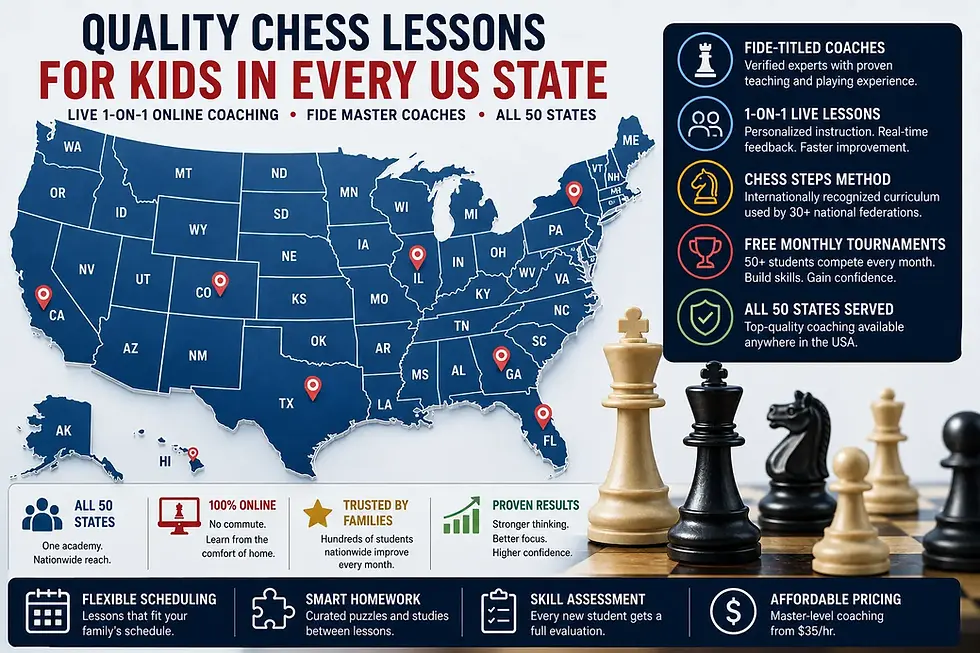
Mid-market ($35/hr — MM Chess Academy): 1-on-1 live coaching, FIDE-titled instructor, structured curriculum, homework, free tournaments.
Premium ($70–$150+/hr): GM-level coaching at large platforms. Same credential level as MM Chess at 2–4x the price.
MM Chess Academy delivers master-level 1-on-1 instruction from $35/hr — the mid-market sweet spot where credentials and accessibility meet. Trial lesson: $9.99 for a full hour including skill assessment.
7. Best Free Resources to Use Alongside Lessons
ChessKid.com — Best for kids aged 5–12
ChessKid.com — child-safe, animated, gamified Adventure Mode. Puzzle trainer auto-calibrates to difficulty. MM Chess coaches assign ChessKid homework for younger students.
Lichess.org — Best for intermediate players and adults
Lichess.org — 100% free, no ads. Puzzle trainer with 800,000+ puzzles. Learn section with structured lessons. MM Chess coaches use Lichess for shared-board sessions.
Chessable.com — Best for opening and endgame memorization
Chessable.com — Spaced repetition science for chess theory. Best supplement to live coaching for adults building opening repertoires.
US Chess Federation — Essential for competitive play
uschess.org — USCF rating registration, tournament finder by state and age group. MM Chess monthly tournaments complement USCF events for all active students.
8. Why MM Chess Academy Is the Top-Rated Online Chess Lesson Provider
MM Chess Academy was built to solve one specific problem: American families couldn't access the quality of coaching that produces real chess ability at a price that didn't require treating chess as a luxury.
The roster includes a Grandmaster who was World U14 Champion, a FIDE Master with a licensed psychology credential, and multiple national champions — all verified at ratings.fide.com. Every coach teaches the Chess Steps Method. Every student gets homework. Every active student gets access to free monthly tournaments.
In Chicago, MM Chess runs after-school programs in 20+ schools alongside its online coaching — partnering with the Chicago Chess Center. For families anywhere in the USA, the online experience is identical — same coaches, same curriculum, same pricing.
Further reading: Online Chess Lessons, Tutors & Tournaments Guide · Does Chess Make Kids Smarter? · Can Chess Help Kids with ADHD?
9. Frequently Asked Questions
1. What are online chess lessons and how do they work?
Live, instructor-led sessions over video call and shared digital board. The coach sees your moves in real time, corrects mistakes immediately, and personalizes every session. MM Chess Academy — 1-on-1, live, Chess Steps Method, homework after every session.
2. How much do online chess lessons cost?
Free to $150+/hr depending on format and credentials. FIDE-titled 1-on-1 mid-market: $35–$90/hr. MM Chess offers $35/hr with a $9.99 trial lesson.
3. Are online chess lessons effective for kids?
Yes. Global Online Chess Learning Report 2026 found 167% better improvement with coaching vs self-study. 24-study meta-analysis: math effect 0.382, reading 0.248.
4. Can adults learn chess online effectively?
Absolutely. Adults often progress faster in early stages. Best adult format: weekly 1-on-1 coaching + daily Lichess puzzles or Chessable. MM Chess teaches adults at all levels.
5. How often should I take online chess lessons?
Once per week is standard. NIH research found 25–30 hours of instruction/year is the minimum threshold for meaningful benefits. Students who complete homework between sessions improve twice as fast.
6. What do I need for online chess lessons?
Computer or tablet with internet and webcam. No physical chess set needed — lessons use a shared digital board. MM Chess uses its own beginner platform and Lichess for intermediate students.
7. What age should kids start?
MM Chess Academy teaches from age 5. Most children ready between 5–7. Age matters less than the quality and consistency of instruction.
8. Is 1-on-1 better than group online chess lessons?
Yes for serious skill development. 1-on-1 adapts every session to one student's specific gaps. Group classes are more affordable and social — best as an introduction, not for measurable competitive improvement.
9. How do I find chess tournaments?
USCF tournament finder at uschess.org for local rated events. MM Chess free monthly tournaments for all active students — the most common first competitive experience for MM Chess students.
10. Does MM Chess offer lessons for both kids and adults?
Yes. MM Chess Academy teaches age 5 through adulthood, with specialists in young beginners, competitive scholastic players, and adult learners. Browse the full coach roster.
Your First Online Chess Lesson Is One Click Away
1-on-1 with a FIDE Master. Skill assessment included. For kids aged 5+ and adults at any level. No commitment, no commute, no waitlist.

Comments